
If you’re reading this, you’ve done the inpatient or early outpatient rehabilitation, but you’re still struggling with your arm, the one that was affected by your stroke. You might be thinking: “Why isn’t it working yet? Is this as good as it gets?” The good news is: no, it’s not necessarily the end of the road. There are effective options for continuing your recovery, even after hospital therapy has finished.
Why your arm may still not be working
After a stroke, many people face persistent upper-limb weakness, reduced control, pain, and difficulty doing everyday tasks with the affected arm. Research shows that 50-80% of stroke survivors will experience upper‐extremity function loss which may persist beyond a year. Strokecouncil.org
It’s important to recognise:
- The brain and upper-limb system are complex, and recovery depends on many factors (which side the stroke was on, how much damage there was, how early rehabilitation began, how much movement you still have, etc.).
- Recovery tends to slow down the further you are out from the stroke, but it is still possible – it’s not “game over” once you finish your first round of therapy.
- The amount (dose), the intensity, and the type of therapy matter. Simply doing “some exercises” is rarely enough to drive meaningful change in the long term.
So, what can you do now?
At ONE Rehabilitation Service, we offer continuing rehab pathways that you can join anytime in your recovery, whether you’re a few weeks, several months, or even years out from your stroke. One of our key programs is NeuroBOOST, our group upper‐limb therapy program, designed especially for people whose arm is still not working the way they want.
What is NeuroBOOST?
NeuroBOOST is a 6-week intensive program (3 sessions per week) that focuses on improving upper-limb function through high-volume, evidence-informed therapy and access to specialised equipment.
Our therapy combines:
- Traditional occupational therapy approaches for the upper limb (hands, wrist, arm) and
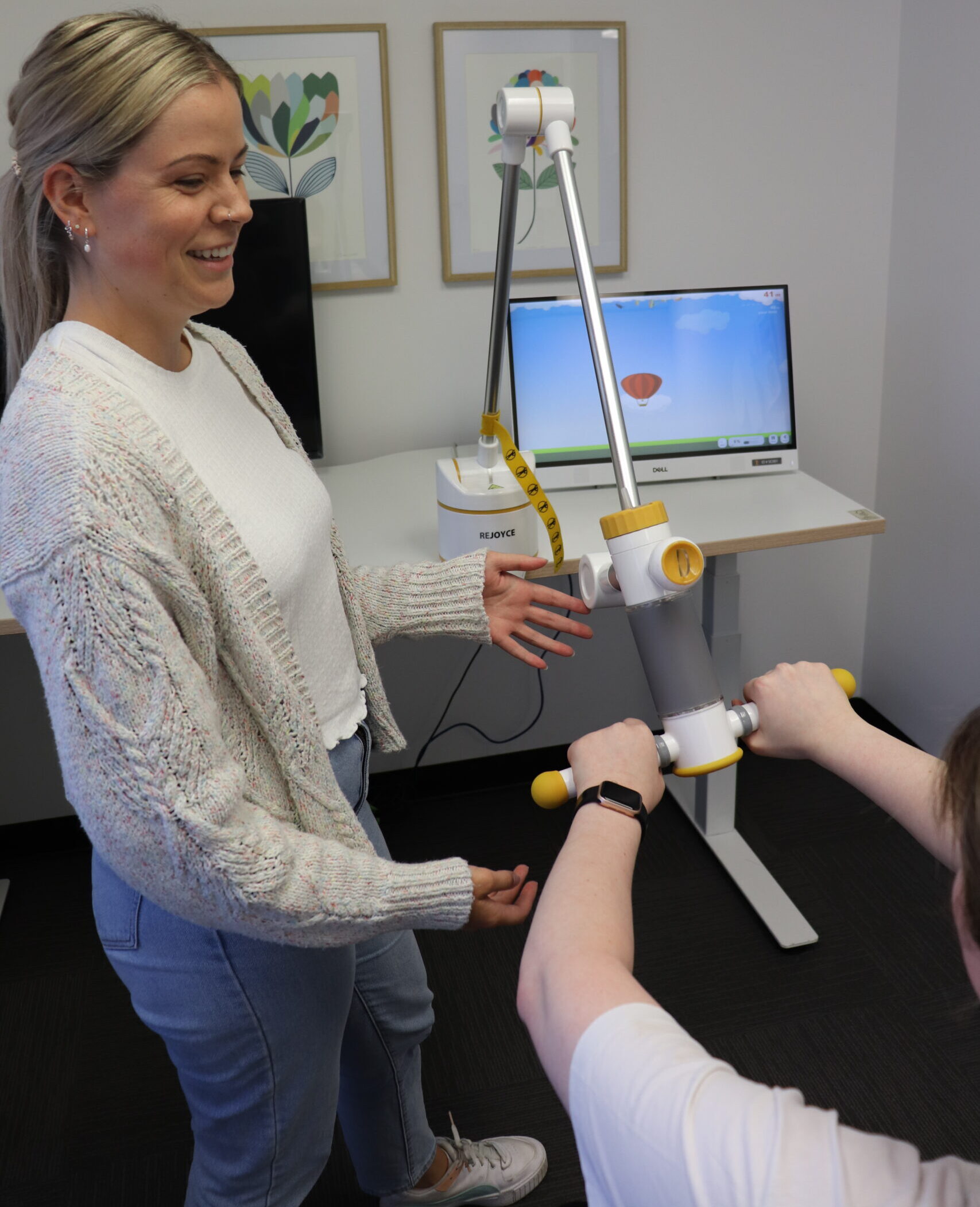
- Modern computer‐based and electronic equipment for interactive, engaging practice.
Why this kind of approach?
Because the evidence shows that for upper‐limb recovery after stroke:
- Rehabilitation should be meaningful, task‐specific, progressively adapted and high‐dose.
- Combining traditional therapy with modern interactive equipment and motivating tasks increases engagement (which matters), repetition and real‐world relevance.
- While some high‐tech therapies (eg robotics) show only small additional gains over conventional therapy, what does matter is the dose/intensity and the meaningfulness of tasks.
What to expect in the NeuroBOOST program
- You’ll attend 3 sessions per week over 6 weeks (a total of 18 sessions) in a group upper‐limb therapy setting.
- Before the program begins we perform baseline outcome measures.
- Through the program you’ll engage in both standard therapy (e.g. purposeful arm/hand tasks) and the interactive/equipment‐based activities (Pablo, Music Glove, Rejoyce).
- At program completion we repeat outcome measures so you and your therapist can see your progress and plan next steps.
- We’ll work with you to set goals that matter to you (for example: reaching for a cup, getting dressed using that arm, prepping meals, or using your arm for work or leisure).
- Because the sessions are relatively intensive and regular, the program is structured and progressive, rather than ad hoc.
Is it too late for me if I’m many months/year out from my stroke?
Absolutely not. While earlier tends to be better, research increasingly supports the notion that ongoing, targeted therapy can drive further improvement, even in the “chronic” phase (months or years post‐stroke) when many believe improvement plateaus.
Why continuing therapy makes sense
- It maintains and strengthens the brain’s capacity for neuroplastic change (the brain’s ability to re‐organise with repeated purposeful movement).
- It counters the risk of “learned non‐use” (when you stop using your arm because it doesn’t work well, so the brain and body give up on it).
- It targets real‐world functional goals, rather than isolated exercises, so your arm becomes more useful in daily life.
- The setting of a structured program with equipment and tasks helps with motivation. Motivation is not trivial: one study found rehabilitation motivation was strongly linked to better upper‐limb motor function outcomes. Frontiers
If you’re wondering, “What will this cost me?” or “Is it feasible for me?”
- At ONE Rehabilitation Service we aim to make it as accessible as possible. Because it’s group‐based, the cost can be lower than one-to-one services.
- The program is run at our clinic, with dedicated equipment and supervision by occupational therapists experienced in neurorehab.
- We’ll assess your eligibility (including checking for contraindications like pacemaker/DBS if equipment like Pablo is used).
- We’ll also work with you on scheduling, goal‐setting and what you’ll need to continue progress after the 6 weeks (yes, there is still “after” the program – we’ll help you plan your next steps).
Steps to get started
- Contact us at ONE Rehabilitation Service and ask about the NeuroBOOST upper-limb program.
- We’ll arrange an initial assessment where we will review your stroke history, current arm/hand function, goals, and determine the best pathway for you.
- If suitable, we’ll enrol you in the next available NeuroBOOST cohort.
- We’ll set meaningful goals together (e.g. “I want to be able to pick up my coffee cup with my left arm” or “I want to use my affected arm for my hobby of gardening”).
- After completion of the 18 sessions, we’ll re-test your outcomes and plan ongoing maintenance or follow‐on therapy.
- We’ll support you to use your improved arm in everyday life, ensuring that the gains translate into activities that matter to you.
Final thoughts
If your arm still isn’t working the way you want after your stroke, you are not alone, and you do have options. The key is not to wait and assume “this is it”. Choosing a structured, evidence-informed program like NeuroBOOST means you’re actively investing in your continued recovery.
At ONE Rehabilitation Service we believe in helping you make your arm count again – for the things that matter in your life. Whether it’s performing self-care tasks, returning to work, hobbies, or simply using your arm with less frustration and more confidence we’re here to support you.
If you’d like more details, eligibility criteria, cost information or available start dates for NeuroBOOST, please contact us (insert contact link) or book an initial consultation.
FAQ
Q: Is the program only for people early after stroke?
A: No – while early therapy is beneficial, our program is designed for people who may be several months or even years post-stroke and still want to work on their arm/hand.
Q: I have little movement in my arm now, can I still join?
A: In many cases yes – we’ll assess your current arm/hand movement, strength, and function to determine suitability and may adapt the program to your level. We also offer individualised therapy that may be of benefit
Q: What if I have a pacemaker or deep brain stimulation?
A: If you have a pacemaker or DBS you unfortunately cannot use certain equipment (such as Pablo) due to safety/contraindications. We’ll discuss which equipment and activities are safe and appropriate for you.
Q: How will I know if it’s working?
A: We use outcome measures before and after the program so we can see your improvement (in movement, control, speed, reactions), and we help you link improvements to meaningful goals in your daily life.